Friday, 25 August 2017

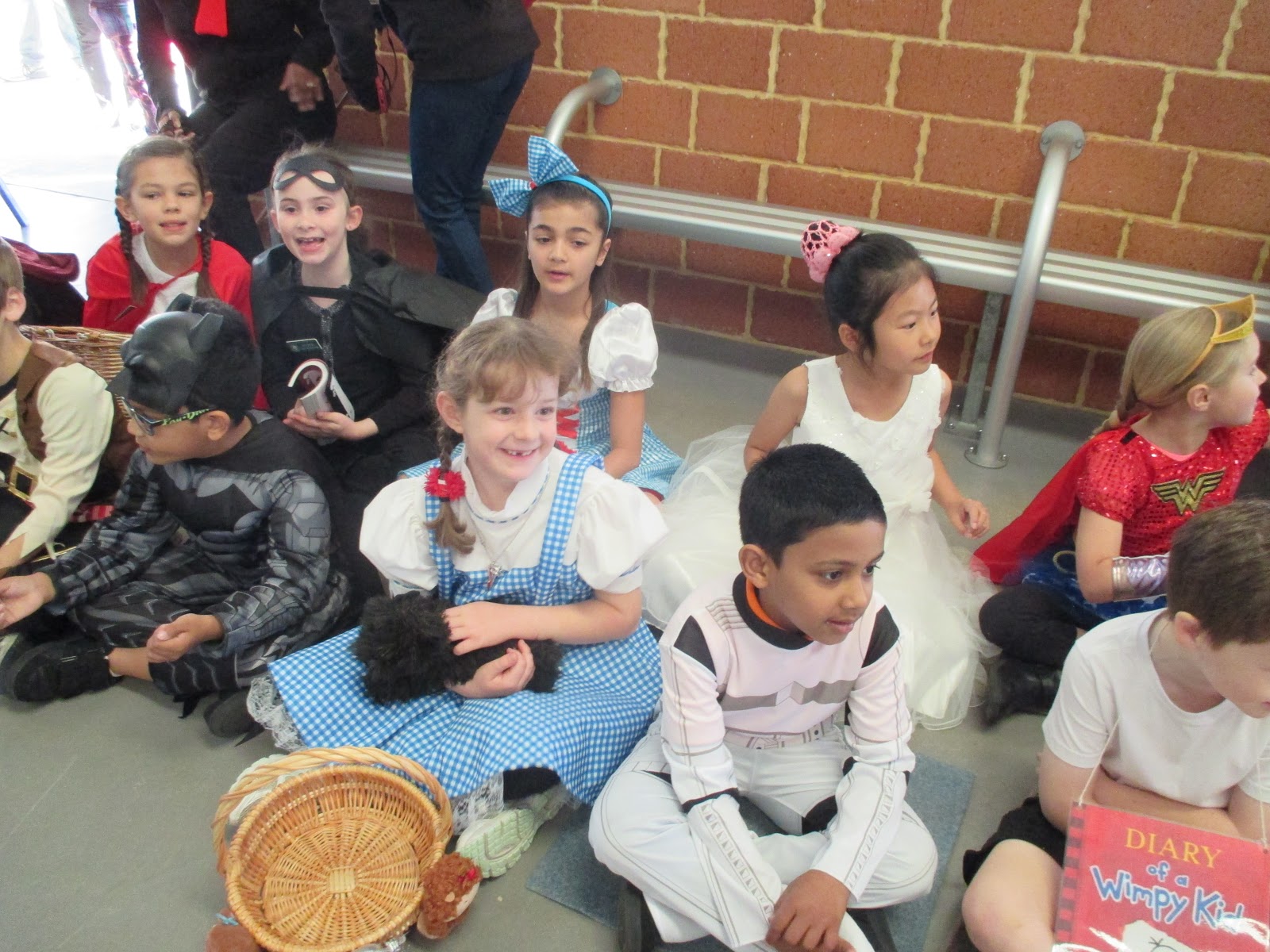
Book Week Parade

Today we celebrated Book Week by dressing as our favourite book characters and parading in the undercover area. Can you guess who we are?

Thank you to the parents/carers for your amazing efforts with the costumes. :)


Monday, 21 August 2017

Mathematics: Telling Time

This week we are continuing our focus on telling time using analogue and digital clocks to the hour, half hour, quarter past and quarter to. The picture below is a Kagan (cooperative learning) activity called Quiz, Quiz, Trade. The students moved around quizzing each other with their newly made watches.


Week 6 Writing Prompt

This week's writing prompt is a seal pup. We are continuing to write narratives (creative stories), so students should spend some time thinking of describing words to explain how the pup looks, acts/behaves, feels, thinks, etc. Describing the scenery and thinking of a problem in the story would also be great discussion points.


Book Week Speaking and Listening Task

This week we are celebrating Book Week. All students have been asked to present a talk about their Book Week character. Below are some questions they could discuss in their presentation.

Tomorrow we will be preparing for the talk and practising in our home groups before the final presentations which will begin on Wednesday.


                 Think about the following things:
1. What is the character like? Think about describing words.
2. Do they have any friends or enemies?
3. What is their favourite thing to do?
4. What happens to them in the story?
5. What would you do if you met them?
6. What questions would you ask them?

Your presentation must not last any longer than 2-3 minutes. 

Wednesday, 9 August 2017

Week 5 Narrative picture prompt

As promised, this week's picture prompt is below. Please discuss the prompt with your child. Ask them what the character in the image might hear, see, touch, smell and even taste. What might be happening? What might the character be thinking and feeling? What could the problem/complication be? What will the character do next? Remember the activity is a discussion and not a written activity. We want students to expand their vocabulary and to come to school ready to share some creative story ideas. 
Flying high

Sunday, 6 August 2017

Term 3

ENGLISH
Over the past three weeks we have continued to refine our writing of persuasive texts. We will be moving onto narrative text structure next week. Daily reading with your child will help them to develop an understanding of text structures, ideas and vocabulary.

“Talk” homework has been placed on the homework sheets at the bottom of the Word Problem Wednesday. It's been great to hear the broader range of discussion that has resulted from the topics sent home so far. A reminder that there is no writing involved, just speaking. This assists students to develop a wider range of topic specific vocabulary and ideas in readiness for their writing. Please see me if you need further details.

Guided Reading books will continue to be sent home after their initial use in class. Please remind your child to return these each day as they are used throughout the week. It is pleasing to see so many students remembering to do this.


MATHS

This term we have investigated addition strategies. Students have been learning that there are many different ways to answer the same problem. Using a range of strategies such as adding to ten, doubling, halving, adding 0, partitioning numbers into tens and ones, all have their place when adding numbers quickly. We will be reviewing these later in the term. Parents can support their children by playing addition games where quick recall of two small numbers is required.

We have commenced a unit on money and in the coming weeks we will explore telling time to the quarter hour and reading and understanding calendars. Parents are encouraged to discuss these concepts at home by allowing children to handle money, add up the cost of items and to read clocks and calendars.

SCIENCE

This term we will be investigating push and pull forces and their effect on objects. Well done to all the parents who supported their children to complete last week's homework. This was to spark their curiosity and to demonstrate that push and pull forces are everywhere in our daily lives. Over the next few week's we will be using this information and looking deeply into buoyancy, magnets, gravity and friction.

SCIENCE, TECHNOLOGY, ENGINEERING AND MATHEMATICS 
(STEM)

Our STEM projects this term will link with our Science program. Students will use their understanding of forces to problem solve and create objects. These might include parachutes, ramps, rafts, magnetic mazes, etc. Stay tuned - it should be fun!


Developing Independence

This term, Room 14 students will be encouraged to demonstrate more independence when they arrive at school. This is in line with the school newsletter item which is attached below. I have talked to the students about this and we have formulated some steps we will take each day, including: carrying and hanging their own bag, organising their desk, chair and equipment and lastly completing their morning work activity by themselves or with a student partner. By the end of the week, we will also say goodbye to our parents at the door, rather than be escorted in. Please see me if you have any questions about this approach.

This appeared in the school newsletter in Week 8, Term 2.

Developing Independence

At Wattle Grove Primary School, we aim to provide a learning environment that encourages the opportunity for all students to achieve their personal best. There are a number of ways that families can support their child in these areas.

1. Commit to your child going to school every day on time.
One of the most important things you can do to ensure your child has a bright future is to make sure he or she goes to school every day – and gets there on time.

2. Make sure your child gets enough sleep.
A good night’s sleep consolidates learning, as well as assists future learning. Children need between 10-12 hours of sleep each day. Help kids get sufficient sleep by having a regular bed-time and get-up time each day.

3. Establish work & study habits.
The most successful students are those that develop regular study habits that suit their lifestyle, their study style and their school’s expectations.

4. Develop self-organisational skills.
Successful students are often well-organised, self-directed and self-motivated. Such skills as packing school bags and organising morning routines can be great lessons that impact on how kids perform at school.

Throughout the year, we encourage students to develop their independence by completing their classroom morning routines by themselves. Research has shown that a structured and organised morning routine is conducive to successful student learning. Our focus is on developing this classroom environment, particularly in all Year 2-6 classes. Children are encouraged to enter the classroom prepared to independently organise themselves for the school day ahead.  We look forward to working with parents to ensure the success of this whole school approach.